
By Dr. Tonya Westerbeke, D.C. | Back To Health Chiropractic | Zeeland, Portage & Muskegon, MI
Let Me Challenge What You've Been Told About Sciatica
Let's start with the truth most people never hear: sciatica is not a diagnosis. It’s a symptom. And if you've been treating it like a condition instead of a signal—if you've been handed a prescription, told to rest, or sent to physical therapy without ever identifying why that nerve is irritated in the first place—that’s exactly why it keeps coming back.
I see this pattern every single week at Back To Health Chiropractic. Patients walk into our Zeeland, Portage, and Muskegon clinics after months—sometimes years—of the same cycle: flare up, medicate, rest, repeat. They’ve tried everything. And they’re exhausted. Sound familiar?
The good news? Sciatica responds incredibly well to chiropractic care when you address the actual root cause. And that is precisely what we do.
What You’ll Learn in This Post:
- What sciatica actually is (and what it isn’t)
- The 7 most common causes your doctor may have missed
- Why it keeps coming back (and what breaks the cycle)
- How chiropractic care addresses sciatica at the root
- What your first visit at Back To Health looks like
- Local resources in West Michigan to support your recovery
2026 Fast Fact: Sciatica affects up to 40% of adults at some point in their lifetime, and rates are increasing among adults under 45 due to sedentary lifestyles and long hours at screens. (Source: Spine Journal, 2025)
First: What Is Sciatica, Really?
The sciatic nerve is the longest nerve in your body. It originates from several nerve roots in your lower lumbar spine (L4, L5, S1, S2, S3), merges into one large nerve, travels down through your buttock, and branches all the way to your foot. When something compresses or irritates any part of that pathway, you feel it—hard.
Sciatica symptoms include:
- Sharp, shooting pain from the low back down one leg (sometimes both)
- Burning or electric-shock sensations down the back of the thigh or calf
- Numbness or tingling in the leg, foot, or toes
- Weakness in the leg or foot—“foot drop”
- Pain that worsens with sitting, sneezing, or prolonged standing
Here’s the key takeaway: sciatica is not a disease in and of itself. It’s your nervous system screaming that something is wrong structurally. Which means masking the pain never solves the problem. Identifying the cause does.
7 Reasons Your Sciatica Keeps Coming Back (Updated for 2026)
1. Spinal Misalignment Is Compressing the Nerve Root
This is the most common cause—and the most often overlooked. When the vertebrae in your lumbar spine shift out of proper alignment (what chiropractors call a subluxation), they can compress the nerve roots that form the sciatic nerve. This happens gradually. Postural stress, old injuries, pregnancy, repetitive strain—they all build up over time until one day your body says: enough.
You can take ibuprofen and it’ll quiet the inflammation for a while. But the vertebra is still misaligned. The nerve is still compressed. And the next time you sit too long, sneeze too hard, or reach wrong, it fires right back up. This is why chiropractic adjustment—specific, targeted realignment of the spine—is the only approach that addresses the structural cause directly.
2. Herniated or Bulging Disc
The discs between your vertebrae act as shock absorbers. When the inner gel-like nucleus pushes through the outer disc wall (herniation) or the disc bulges outward, it can press directly on the sciatic nerve. According to research published in Spine, approximately 90% of sciatica cases are caused by disc herniation at the L4–L5 or L5–S1 levels.
The great news: chiropractic care and spinal decompression therapy have both demonstrated significant effectiveness in treating disc-related sciatica. At Back To Health, spinal decompression is one of our most powerful tools for disc cases—gently creating negative pressure in the disc to encourage retraction and healing without surgery.
3. Piriformis Syndrome: The Impersonator
Here’s one that catches a lot of people off guard. The piriformis is a small, deep muscle in your buttock. In most people, the sciatic nerve runs directly beneath it. In some people, it actually passes through the muscle. When the piriformis becomes tight or spasmed—from sitting, overuse, hip imbalance, or pelvic misalignment—it squeezes the sciatic nerve and mimics classic sciatica perfectly.
Piriformis syndrome is frequently misdiagnosed because it doesn’t show up on standard MRI unless you’re looking for it specifically. Our doctors are trained to assess pelvic alignment and muscle function—and we catch this routinely. A combination of targeted adjustments, myofascial therapy, and therapeutic exercises resolves this extremely well.
4. Chronic Inflammation From Poor Lifestyle Habits
Diet, sleep, hydration, and stress aren’t just wellness buzzwords—they directly impact inflammation levels in your body. Chronic systemic inflammation makes nerve tissue more reactive and slower to heal. A 2025 study in the Journal of Pain Research found that patients with higher inflammatory markers had significantly worse sciatica outcomes and longer recovery times.
If you’re eating a high-sugar, processed diet, not sleeping well, or running on chronic stress (I see you, West Michigan moms and professionals), your body is already operating in a pro-inflammatory state that amplifies every flare. This is why we address the whole person at Back To Health—not just the spine.
5. Pregnancy and Pelvic Instability
Sciatica is incredibly common during pregnancy—especially in the second and third trimesters—as the growing uterus puts direct pressure on the sciatic nerve and surrounding structures. Hormonal changes (specifically relaxin) also loosen pelvic ligaments, contributing to misalignment and instability.
What sets Back To Health apart in West Michigan is that our entire clinical team has been trained in pregnancy and pediatric chiropractic at the highest level. As an ICA Diplomate in Pediatric and Pregnancy Chiropractic, I have personally trained every doctor at our Zeeland, Portage, and Muskegon locations to deliver the same standard of care I hold myself to. You don’t have to search for the “right” provider or hope you get the doctor who understands prenatal care—at Back To Health, that expertise is built into every room, at every location. Safe, gentle chiropractic care during pregnancy is not only appropriate—it’s often transformative. Our doctors are all trained in the Webster Technique, specifically designed to reduce pelvic tension and optimize fetal positioning while addressing sciatic discomfort.
6. Sedentary Work and Tech-Posture Collapse
West Michigan is full of hard workers—professionals logging 8+ hours at desks, remote workers hunched over laptops, and workers on their feet all day in positions that load the lower back unevenly. Extended sitting (especially with forward head posture and rounded lower back) dramatically increases disc pressure at L4–S1 and tightens the hip flexors and piriformis—the perfect storm for sciatica.
A 2025 analysis in BMC Musculoskeletal Disorders found that people who sit more than 6 hours per day are 47% more likely to experience recurrent sciatic episodes compared to those who alternate postures regularly throughout the day.
This doesn’t mean you need a new job. It means you need to restore proper spinal mechanics through regular chiropractic care, targeted movement, and better ergonomic awareness. All things we teach every patient at Back To Health.
7. A Previous Injury That Was Never Fully Corrected
This one is big and almost never talked about. Old sports injuries, car accidents, falls, even traumatic childbirths—they leave structural compensation patterns in the spine and pelvis that quietly load the lumbar region for years before sciatica erupts. By the time you feel it, the dysfunction has often been building for a decade.
This is why we take a thorough history with every new patient. We’re not just asking about today’s pain. We’re building a picture of everything your body has been carrying. And then we get to work correcting it.
Why Sciatica Keeps Coming Back: The Cycle Nobody Explains
Here’s the honest answer to the question I hear most: “Why do I keep getting better and then it comes back?”
Because you’re treating the flare, not the fault.
Every time sciatica flares, your body compensates. You shift your weight. You tighten muscles on the other side to protect the injured area. You move differently. Over time, those compensations become habits, then structural patterns, then new sources of dysfunction. You’re not just dealing with the original problem anymore—you’re dealing with layers of damage stacked on top of it.
The only way to break this cycle is to correct the spinal and structural dysfunction at the source, retrain the supporting muscles and movement patterns, and maintain the correction over time. This is exactly the model we use at Back To Health.
The Back To Health Approach to Sciatica:
- Thorough assessment: full history, postural evaluation, orthopedic and neurological testing, X-ray as indicated
- Precise chiropractic adjustment to correct spinal misalignment and restore nerve function
- Spinal decompression therapy for disc-related sciatica
- Myofascial release and soft tissue therapy to address muscle tension and piriformis involvement
- Therapeutic exercise and movement coaching to stabilize the correction
- Vibration plate therapy to enhance neuromuscular re-education
- Education: posture, ergonomics, movement habits, and home care to maintain progress
What the Research Says: Chiropractic and Sciatica
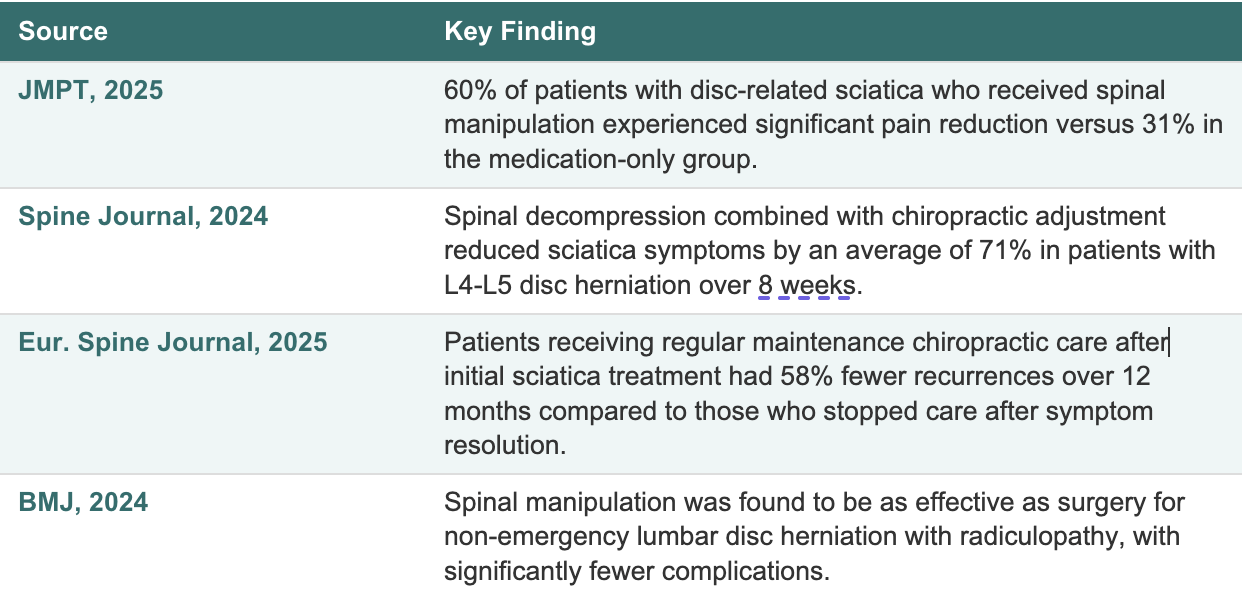
This isn’t anecdote. The evidence is strong—and growing. Here’s a snapshot of what peer-reviewed research tells us:
What to Expect at Back To Health Chiropractic: Your First Visit
I know walking into a new provider’s office can feel daunting, especially when you’ve already been disappointed by the healthcare system. I want you to know what you’re walking into.
Your first visit is never a cookie-cutter experience. Here’s how it actually goes:
- We listen first. A thorough health history, a conversation about your pain, your lifestyle, your goals.
- We assess your whole spine—not just where it hurts. Sciatica is often the result of dysfunction somewhere that isn’t even painful yet.
- We look at your posture, your movement patterns, and your nervous system function.
- We take X-rays when indicated to see exactly what’s happening structurally.
- We give you a real explanation—no vague ‘you have inflammation.’ We show you what we found and build a care plan that makes sense for your life.
- We adjust with precision—not force. Many patients feel a noticeable shift after even the first visit.
We have eleven doctors across our three locations in Zeeland, Portage, and Muskegon—which means you’ll get in fast and get consistent, high-quality care every time you walk through our doors. No waiting weeks for an appointment. No rotating through providers who don’t know your history. We know you.
West Michigan Resources to Support Your Sciatica Recovery
Healing doesn’t happen only in our clinic. West Michigan has incredible resources to support your recovery journey. Here are some we love:
- Movement & Core Strength: Local yoga and Pilates studios focusing on alignment and controlled movement are outstanding complements to chiropractic care for sciatic patients. Ask us for our current favorites near your location.
- Ergonomic Workstation Support: Many West Michigan businesses now offer standing desk options and ergonomic assessments. If you’re in a sedentary role, this matters enormously.
- Aquatic Therapy & Warm Pools: Gentle water movement reduces compressive forces on the spine while maintaining mobility—ideal for acute sciatic flares. Several YMCA locations across Zeeland, Portage, and Muskegon offer aquatic programs.
- Mental Wellness: Chronic pain takes a toll mentally. West Michigan has a strong community of counselors and mindfulness practitioners who can partner beautifully with your physical recovery.
Frequently Asked Questions About Sciatica and Chiropractic Care
Q: Is chiropractic safe for sciatica?
Yes—and it’s one of the most evidence-backed conservative options available. Chiropractic adjustment for lumbar radiculopathy (sciatica) has been studied extensively. Research consistently shows it is safe, effective, and preferable to prolonged medication use for most patients. Always inform your chiropractor of any red flag symptoms (bowel/bladder changes, severe bilateral leg weakness) which would warrant immediate referral.
Q: How long does it take for chiropractic to fix sciatica?
It depends on how long the underlying problem has been building. Most patients experience meaningful relief within 4–6 visits. For chronic or complex cases (long-standing disc herniation, significant postural decompensation), a full corrective care plan may span 8–16 weeks. We’ll give you an honest timeline after your initial assessment—no vague promises, no unnecessary extended care.
Q: Will I need surgery?
The vast majority of sciatica cases do not require surgery. Conservative chiropractic care, including spinal decompression, resolves the underlying dysfunction in most disc-related cases. A 2024 BMJ study found spinal manipulation is as effective as surgery for non-emergency disc herniation with radiculopathy. Surgery is typically only considered when neurological deficits are severe, rapidly worsening, or when conservative care has been genuinely exhausted—which, with proper chiropractic treatment, is rare.
Q: Can sciatica go away on its own?
Sometimes acute sciatic episodes do calm down on their own. But ‘going away’ and ‘being fixed’ are not the same thing. If the structural cause is not corrected, the nerve will be irritated again. And every cycle of inflammation adds scar tissue and further degeneration to the affected segments. Don’t wait for it to come back worse. Get the root cause assessed now.
Q: Can I come in during a sciatica flare?
Yes. In fact, we encourage it. Gentle chiropractic care during a flare is appropriate and often immediately relieving. We adjust our techniques based on your current level of pain and inflammation—you will never be forced into an uncomfortable position. Walking in during a flare is far better than lying at home waiting it out.
The Bottom Line: You Don’t Have to Keep Living Like This
Sciatica is not your new normal. It’s not ‘just part of getting older.’ It’s not something you manage forever with medication and willpower. It is a structural problem with a structural solution—and that is exactly what we are trained to deliver.
At Back To Health Chiropractic, we don’t just adjust spines. We restore function. We rebuild capacity. We give people their lives back. And I mean that in the most literal sense: I watch it happen every single week in our clinics across West Michigan.
If sciatica has been stealing from you—your sleep, your mobility, your mood, your ability to be fully present for your family and your work—it’s time to stop letting it win.
You were made to move. Let’s get you back to it.
📅 Ready to Finally Fix Your Sciatica?
Book your new patient appointment online — it takes less than 2 minutes:
➡ bthclinics.com/locations
Or call us directly:
Zeeland: 616.546.3500 | Portage: 269.345.2273 | Muskegon: 231.830.1111
FREE Download: “5 Sciatica-Relief Stretches You Can Do Today”
Grab our free guide with five gentle, chiropractor-approved stretches designed specifically for sciatic nerve relief. Works for desk workers, active adults, and everyone in between. Drop your name and email at the link below to download instantly.

Dr. Tonya Westerbeke
TAGS
RECENT POSTS