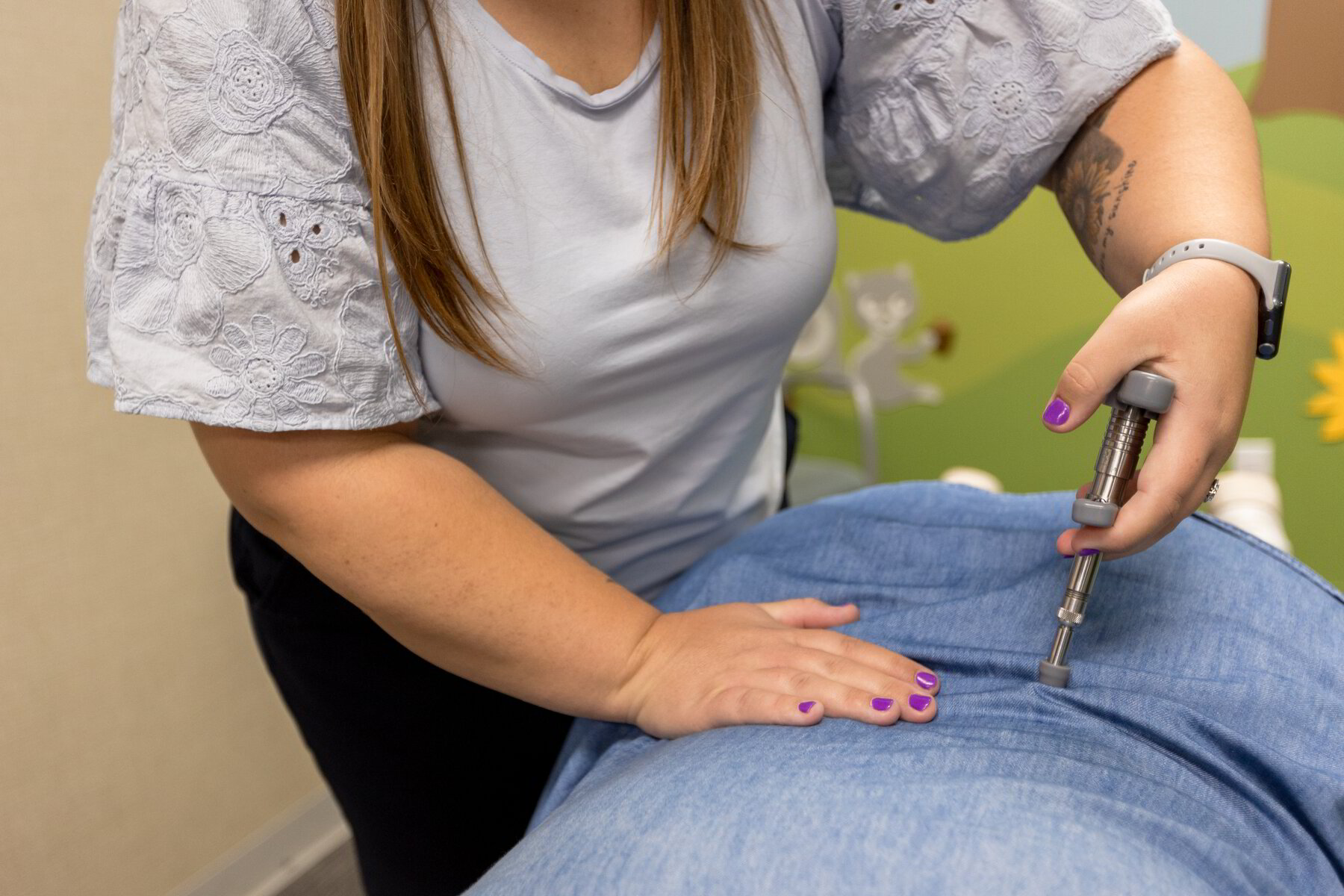
If you've been told to "rest it and see how it goes" — but the burning down your arm or leg hasn't let up — here's what's actually happening inside your spine, and what can be done about it.
By Dr. Tonya Westerbeke, DC | Back To Health Chiropractic Updated for 2026
You've already been to urgent care. Maybe your primary doctor. You got the muscle relaxer, the anti-inflammatory, the "give it six weeks" speech. The imaging came back "unremarkable." And yet — you still can't sleep on your left side. Your hand still goes numb when you drive. That electric zing still shoots from your low back into your calf every time you stand up from your desk.
Let's be honest: being told nothing is wrong when something is very clearly wrong is its own kind of exhausting.
Here's what you'll learn: what a pinched nerve actually is, why the pain shows up far from the problem, what the research says about chiropractic care for it, and the red flags that mean you need medical attention right now.
And you're not an outlier. Lumbosacral radiculopathy — the clinical term for a pinched nerve in the low back — affects an estimated 3 to 5% of adults at some point in life, with the L5 nerve root the single most commonly involved level ( Radicular Back Pain, StatPearls, U.S. National Library of Medicine ).
You'll see far larger numbers online. In Spine , Konstantinou and Dunn (2008) found sciatica prevalence estimates vary widely across studies, driven by how sciatica gets defined and measured. Translation: it's common, and the scarier figure isn't necessarily wrong — it's counting something different.
7 Things You Need to Know About Pinched Nerves — Updated for 2026
1. A "pinched nerve" is rarely pinched where you feel it
This is the single biggest misconception we see in our offices.
Your nerve roots exit the spine through small bony windows called intervertebral foramina . When a disc bulges, a joint swells, or a vertebra loses normal motion, that window narrows. The nerve root gets compressed or chemically irritated at the spine — but symptoms show up wherever that nerve travels.
So an L5 nerve root compressed at the L4-L5 level sends symptoms down the outside of your calf and into your big toe. A C6 nerve root irritated in your neck produces numbness in your thumb and index finger. You're rubbing your hand. The problem is in your neck.
This is why chasing the symptom rarely works. We look upstream.
2. Not all nerve compression comes from a disc
Discs get the blame, but they're one of several culprits:
- Disc herniation or protrusion — most commonly at L4-L5 and L5-S1 in the low back, C5-C6 and C6-C7 in the neck
- Facet joint inflammation and degenerative narrowing of the foramen
- Piriformis involvement — the sciatic nerve passing through or near a tight, overworked piriformis muscle in the deep hip
- Peripheral entrapment — the median nerve at the carpal tunnel, or the brachial plexus compressed at the thoracic outlet
Two people can walk in with identical leg pain and have entirely different mechanisms. That's why a real exam matters more than a guess.
3. Your symptoms tell us which nerve root is involved
A thorough evaluation isn't just "where does it hurt." Our doctors assess dermatomal patterns (which skin territory is numb), myotomal strength (which muscle is weak), and deep tendon reflexes at the patella and Achilles, plus orthopedic testing — straight leg raise, Spurling's test, slump test — to localize the irritation.
That combination tells us the level. And the level tells us how to treat it.
4. Inflammation is half the story
Nerve compression isn't purely mechanical. When the outer wall of a disc tears, the inner nuclear material leaks out and triggers a chemical inflammatory cascade around the nerve root — inflammatory mediators that sensitize the nerve even when physical pressure is modest.
This is why some people with dramatic MRI findings have almost no pain, and others with "clean" imaging are miserable. It's also why care that addresses movement, circulation, and inflammation together tends to outperform care that addresses only one.
5. Chiropractic care for nerve compression is more than the adjustment
Our team uses a comprehensive approach built around restoring motion to the segment that lost it, and reducing the load on the irritated nerve:
- Specific spinal adjustments to restore joint motion at the involved level
- Spinal decompression to reduce intradiscal pressure and create space at the foramen
- Class IV laser therapy to target the inflammatory component of nerve root irritation — often our first move in acute, highly sensitive cases where hands-on care isn't yet comfortable
- Instrument-assisted soft tissue mobilization (IASTM) and cupping for the surrounding muscular restriction
- Nerve glides and stabilization exercise you'll do at home — because what you do between visits matters as much as what happens on the table
- Ergonomic and lifestyle coaching — the desk setup in Zeeland, the lift technique on the Muskegon shop floor, the hours in the car on US-31
You were built to move. Our job is to remove what's stopping you.
6. The research is real — and honest
This is where we won't oversell.
Trager et al. (2022). "Association between chiropractic spinal manipulation and lumbar discectomy in adults with lumbar disc herniation and radiculopathy." BMJ Open, 12(12):e068262. Using a 101-million-patient U.S. records network with propensity-score matching (5,785 patients per cohort), adults receiving chiropractic spinal manipulative therapy for newly diagnosed lumbar disc herniation or lumbosacral radiculopathy had significantly reduced odds of lumbar discectomy over both 1-year (OR 0.69) and 2-year (OR 0.77) follow-up compared with those receiving other care. The authors note the observational design precludes inferring causality.
Bronfort et al. (2014). "Spinal Manipulation and Home Exercise With Advice for Subacute and Chronic Back-Related Leg Pain." Annals of Internal Medicine, 161(6):381–391. Spinal manipulative therapy combined with home exercise and advice provided more relief from back-related leg pain than home exercise and advice alone at 12 weeks — though the difference was not sustained at 52 weeks.
Young et al. (2019). "Immediate and Short-term Effects of Thoracic Spine Manipulation in Patients With Cervical Radiculopathy: A Randomized Controlled Trial." Journal of Orthopaedic & Sports Physical Therapy, 49(5):299–309. Participants with cervical radiculopathy received either real thoracic spine manipulation (n=22) or a sham (n=21). Neck pain dropped an average of 1.9 points on the numeric pain-rating scale in the manipulation group versus 0.1 in the sham group. A single session improved pain, disability, cervical range of motion, and deep neck flexor endurance. Worth noting honestly: small sample, short-term effect, and long-term outcomes weren't assessed.
Konstantinovic et al. (2010). "Low-Level Laser Therapy for Acute Neck Pain with Radiculopathy: A Double-Blind Placebo-Controlled Randomized Study." Pain Medicine, 11(8):1169–1178. Sixty patients with acute neck pain and radiculopathy received 15 sessions of either active laser or an inactivated placebo. The active group showed significantly greater arm pain relief and neck extension range, both with large effect sizes. One distinction we'll state plainly: this trial used low-level laser, while Class IV is higher-powered. Same mechanism — photobiomodulation — different dosing, and Class IV research specifically is still developing.
What the evidence supports: chiropractic care is a reasonable, conservative first line for many people with nerve root compression, with a favorable safety profile. What it doesn't support: guarantees. Every spine is different, and we'll tell you honestly if we're not the right fit.
7. Waiting isn't neutral
We're not here to scare anyone. But prolonged nerve compression can lead to lasting changes in sensation and strength, and the longer a joint stays restricted, the more surrounding tissue adapts around the dysfunction.
This might be uncomfortable to hear: "waiting to see if it goes away" is itself a decision. Better to get evaluated early, find out what you're dealing with, and then choose.
When to Seek Immediate Medical Attention
Chiropractic care is appropriate for most nerve compression cases. It is not appropriate as a first step for these. Go to an emergency department or call your physician right away if you experience:
- Loss of bladder or bowel control , or numbness in the saddle/inner thigh region — possible cauda equina syndrome, a surgical emergency
- Rapidly progressing or profound weakness — foot drop, inability to lift your arm, a leg that gives out
- Fever with severe spinal pain , or unexplained weight loss alongside new back pain
- Nerve symptoms following significant trauma — a fall, a crash, a hard hit
- A history of cancer with new, unrelenting spinal pain
Our doctors screen for every one of these on your first visit. If you need a different provider, we'll say so and help you get there.
Frequently Asked Questions
How long does a pinched nerve take to heal? It varies with cause, duration, and severity. Many people notice meaningful change within a few weeks of consistent care; longstanding compression takes longer. We reassess objectively rather than guessing.
Can a chiropractor make a pinched nerve worse? A thorough exam exists precisely to prevent that. When our doctors find something that contraindicates adjusting — or red flags like those above — we modify the approach or refer out. Care is matched to the person, not the diagnosis code.
Do I need an MRI before I come in? Usually not. Clinical examination identifies the involved nerve root in most cases. If imaging would change the plan, or red flags are present, we'll order or refer for it.
Is it a pinched nerve or just a muscle? Muscular pain is dull, local, and worse with direct pressure. Nerve pain is sharp, burning, or electric, travels in a defined line, and often brings numbness, tingling, or weakness. If it travels, get it checked.
Can chiropractic help a pinched nerve in the neck? Yes — cervical radiculopathy is one of the more common presentations we see, often with symptoms into the shoulder blade, arm, or fingers.
The Bottom Line
A pinched nerve is a real, identifiable, treatable problem — not something to white-knuckle through. It starts at the spine, it involves both mechanical pressure and inflammation, and the evidence supports conservative chiropractic care as a reasonable place to begin for many people.
Your nervous system is the foundation of everything your body does. When it's compressed, everything downstream suffers. We're not here to settle for managing that — we're here to help you resolve it.
Ready to find out what's actually going on?
→ Schedule online: bthclinics.com/locations
→ Or call the location nearest you:
Zeeland: 616.546.3500
Portage: 269.345.2273
Muskegon: 231.830.1111
→ Free download: "5 Nerve Glides for Sciatica and Arm Pain You Can Do at Your Desk" — a one-page guide from our team. [Get it here. ]
You get to rewrite this story. Let's get to work.
References
- Trager RJ, Daniels CJ, Perez JA, Casselberry RM, Dusek JA. "Association between chiropractic spinal manipulation and lumbar discectomy in adults with lumbar disc herniation and radiculopathy: retrospective cohort study using United States' data." BMJ Open. 2022;12(12):e068262. doi:10.1136/bmjopen-2022-068262. PubMed
- Bronfort G, Hondras MA, Schulz CA, Evans RL, Long CR, Grimm R. "Spinal manipulation and home exercise with advice for subacute and chronic back-related leg pain: a trial with adaptive allocation." Annals of Internal Medicine. 2014;161(6):381–391. doi:10.7326/M14-0006. Full text
- Young IA, Pozzi F, Dunning J, Linkonis R, Michener LA. "Immediate and short-term effects of thoracic spine manipulation in patients with cervical radiculopathy: a randomized controlled trial." Journal of Orthopaedic & Sports Physical Therapy. 2019;49(5):299–309. doi:10.2519/jospt.2019.8150. Full text
- Konstantinou K, Dunn KM. "Sciatica: review of epidemiological studies and prevalence estimates." Spine (Phila Pa 1976). 2008;33(22):2464–2472. doi:10.1097/BRS.0b013e318183a4a2. PubMed
- Konstantinovic LM, Cutovic MR, Milovanovic AN, Jovic SJ, Dragin AS, Letic MDj, Miler VM. "Low-level laser therapy for acute neck pain with radiculopathy: a double-blind placebo-controlled randomized study." Pain Medicine. 2010;11(8):1169–1178. doi:10.1111/j.1526-4637.2010.00907.x. PubMed
- Radicular Back Pain. StatPearls. Treasure Island (FL): StatPearls Publishing. NCBI Bookshelf
This article is for educational purposes and is not a substitute for individualized medical evaluation. Back To Health Chiropractic serves families across West Michigan.